
What Is a Solar Battery and How Does It Store Power for Your Florida Home?
Share:
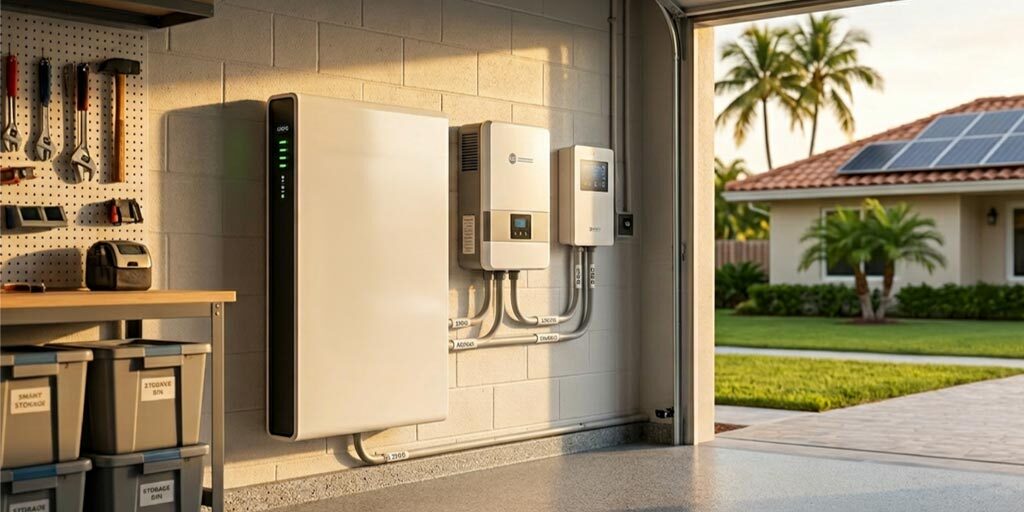
After Hurricane Ian in 2022, millions of Florida homeowners lost power for days. When Hurricane Idalia struck the Big Bend coast in 2023, and Hurricane Milton tore through the Tampa Bay area in 2024, the pattern repeated. The question homeowners started asking was “will solar keep my power on when it matters?”
That’s the job of a solar battery. Solar power storage in Florida transforms a standard grid-tied system from a bill-reduction tool into a whole-home backup solution. This guide explains how home battery backup works, what today’s systems can realistically power, and how to size storage for your home.
Key Takeaways
- Panels don’t back up power alone — grid-tied solar shuts off automatically during outages; a battery is what keeps your home running
- Night and storm coverage — a battery stores surplus daytime energy for overnight use and keeps critical loads running when the grid goes down
- Size to your priorities — essential-load backup, whole-home coverage, and overnight optimization each call for different system sizes
- Florida tax breaks apply — both the property tax exemption and sales tax exemption cover battery storage, not just panels
How a Solar Battery Stores and Releases Energy
How do solar batteries work?
The answer is that the core principle is straightforward: they capture electricity your panels produce but your home doesn’t immediately need, hold it, and release it on demand.
The basic cycle works like this:
- Your panels generate DC electricity from sunlight.
- An inverter converts that to AC power your home can use.
- Any electricity your home doesn’t consume in real time gets stored in the battery rather than exported to the grid.
- When the sun sets or demand spikes, the battery discharges and powers your home.
Without a battery, surplus solar is sent back to the grid under Florida’s net metering program. You earn bill credits but no stored reserve. With a battery, you keep more of what your panels produce and build an independent energy cushion.
Reading tip: What Is Net Metering and How Does It Lower Your Florida Electric Bill?
How Much Can a Battery Store?
Capacity is measured in kilowatt-hours (kWh). According to EIA’s 2020 Residential Energy Consumption Survey, the average Florida household uses around 38 kWh per day. No single residential battery covers that entirely, so most homeowners use storage to power priority loads rather than the whole house through a multi-day outage.
Common options and starting capacities:
- Tesla Powerwall: 13.5 kWh, starting around $16,000
- Enphase IQ Battery: 3.84 kWh per unit, stackable, starting around $10,000
Multiple units can be combined to increase total capacity.
How Solar Panels and Batteries Work Together During an Outage
The most common misconception about solar in Florida: that panels alone keep the lights on during a storm.
Why panels shut off during outages
Standard grid-tied solar systems are required by electrical code to shut down when the grid loses power. This is a safety measure as it prevents electricity from backfeeding into utility lines where workers may be making repairs. A solar-only system goes dark during an outage even on a clear, sunny day.
What changes with a battery
A properly configured battery system creates what’s called an “island,” a protected electrical circuit that keeps running even after the grid drops. Your panels continue generating during daylight hours of the outage. That power flows to the battery and to whichever circuits you’ve designated as backup loads: refrigerator, lights, phone chargers, internet, medical equipment. The battery discharges overnight and recharges when the sun comes back up.
Why this matters in Florida
Ian knocked out power for an estimated 2.6 million Florida customers at its peak — one of the largest outages in state history. For homeowners with battery-paired solar, the experience was different. Tampa resident Donald Kirk, a solar-plus-storage customer, told media at the time that his system “was our essential thing when the power went down” during Ian. His account was one of many reported across the state after the storm Homeowners with battery backup for their solar systems didn’t have to worry about finding fuel for a generator or waiting on restoration timelines.
What Solar Batteries Can and Can’t Cover
Sizing storage correctly starts with knowing what you’re trying to run.
Essential loads (covered by most single-battery systems)
- Refrigerator and freezer
- Lights and ceiling fans
- Phone and device charging
- Internet router and security system
- Small appliances used intermittently (microwave, coffee maker)
- Medical equipment (CPAP, oxygen concentrators)
Higher-draw loads (require larger or multi-battery setups)
- Central air conditioning (3–5 kW or more — possible, but depletes storage faster)
- Electric water heater
- EV charging
- Electric range or dryer
Most Florida homeowners prioritize essential-load backup rather than full-home coverage. Research from Lawrence Berkeley National Laboratory found that a modest solar-plus-storage system can power critical home loads — including refrigeration and nighttime lighting — for days during a typical outage. Heating and cooling require more capacity, but for essentials, a single-battery system does the job.
Does Solar Storage Work at Night?
Without a battery, no. Grid-tied panels don’t produce usable power after dark, and a solar-only system draws from the grid as usual through the evening.
With a battery:
| Time of Day | What Happens |
| Peak sun hours | Panels generate power; battery charges on surplus |
| Late afternoon / evening | Battery discharges; grid draw drops |
| Overnight | Battery continues supplying home loads |
| Morning | Panels resume; battery recharges |
For homeowners on time-of-use utility rates — where grid electricity costs more during peak evening hours — discharging stored solar during those windows adds measurable bill savings on top of the backup benefit.
Florida Incentives for Battery Storage
State Tax Exemptions
Florida doesn’t have a state-level rebate specifically for residential batteries, but two existing exemptions apply:
- Property tax exemption: Solar energy systems, including batteries installed as part of a solar installation, are excluded from property tax assessments through December 31, 2037.
- Sales tax exemption: Solar equipment — including storage — is 100% exempt from Florida’s 6% sales tax.
Utility VPP and Demand-Response Programs
Florida utilities are increasingly rolling out Virtual Power Plant (VPP) and demand-response programs that pay battery owners bill credits for sharing stored energy back to the grid during peak hours. Availability depends on your utility and location, but several programs are already active:
- SECO Energy (Central Florida): Partners with Tesla to pay Powerwall owners $1/kW installed per month, plus $0.30/kWh for energy dispatched during peak events.
- Duke Energy Florida (Hunter’s Creek pilot): A 10-year residential pilot in the Orlando area using battery systems to support the grid during high-demand periods.
- Tampa Electric (TECO): Running research pilots using battery storage to shave peak demand and support grid reliability.
- JEA (Jacksonville): Offers battery storage incentives and rebates to offset upfront installation costs.
These programs are expanding but not yet universal. Check with your local utility for current availability.
Choosing the Right Battery for Your Home
The right system comes down to three things: your backup priorities, how you want to use storage day-to-day, and your budget.
Priority 1: Storm preparedness (essential loads)
For most Florida homeowners, this is the baseline. A single Tesla Powerwall or a multi-unit Enphase stack covers refrigerator, lights, fans, and charging for 12–24 hours on a full charge — longer if panels are recharging the battery during daylight hours of the outage. Small systems run from around $12,000 to $16,000 installed.
Priority 2: Extended outage coverage or HVAC backup
Running air conditioning through a multi-day storm outage requires more capacity. A medium system (20–30 kWh, starting around $20,000) handles most of a home’s load through a full day, cycling through daytime recharge and overnight discharge. This tier suits homeowners who weathered Ian or Milton and want meaningful coverage, not just essentials.
Priority 3: Whole-home backup and near-grid independence
Large storage systems (40+ kWh, starting around $35,000) support the full home — HVAC, water heater, major appliances — across extended events. These are also the right choice for homeowners pursuing meaningful energy independence from the grid as a long-term goal.
Solar Battery Storage in Florida: Common Questions
Do solar panels work during a power outage?
Not without a battery. Grid-tied solar systems are required by code to shut down when the grid loses power — a safety measure that protects utility workers. For solar panels during a Florida outage to keep powering your home, a properly configured battery storage system is required. It creates an isolated backup circuit that keeps your panels generating and your home running.
Do solar panels work at night?
Panels require sunlight to generate electricity and don’t produce power after dark. A battery stores the surplus your system generates during peak sun hours and discharges it through the evening and overnight, reducing how much grid electricity you draw.
How long will a solar battery last during a Florida storm outage?
It depends on battery capacity and which loads you’re running. A single Tesla Powerwall (13.5 kWh) typically runs essential loads — refrigerator, lights, fans, phone charging — for 12 to 24 hours on a full charge. If your panels are producing during daylight hours of the outage, the battery recharges and your runtime extends considerably. Multi-battery setups extend coverage further.
Are solar batteries worth it in Florida?
For homeowners in areas that took direct hits from Ian and Milton, the storm preparedness value is hard to argue with. Beyond emergency use, batteries provide daily value through overnight solar discharge and time-of-use optimization. The right answer depends on your utility rates, how long you want backup coverage, and what it’s worth to you to keep the lights on through the next major storm.
What tax incentives apply to battery storage in Florida?
Florida’s property tax exemption and sales tax exemption both extend to battery storage installed as part of a solar system. Some utilities offer additional programs for storage customers — confirm current availability with your utility.
Solar Power Storage for Florida Homes
Florida’s storm history gives battery storage a clarity of purpose that’s harder to find in other markets. If your neighborhood went dark after Ian, Idalia, or Milton, you already know what extended grid outages feel like. Battery storage is what bridges the gap between a solar system that saves you money and one that keeps your home running when the grid can’t.
Florida Electric & Solar installs the Tesla Powerwall and Enphase IQ Battery, sized to your home’s energy usage and backup priorities. Get your free quote, and we’ll walk you through what each system covers and what makes sense for your home.
Related Articles
More insights about Battery Storage

Beginner’s Guide to Solar Battery Storage Essentials

Florida Homeowners: Unlock Benefits of Solar Battery Storage Today

7 Essential Steps for Solar Battery Storage Setup
Ready to Go Solar?
Have questions about solar energy? Our experts are here to help you make the switch to clean, renewable energy.