
Don’t Ignore This: The Risks of Delaying Solar Panel Installation
Share:
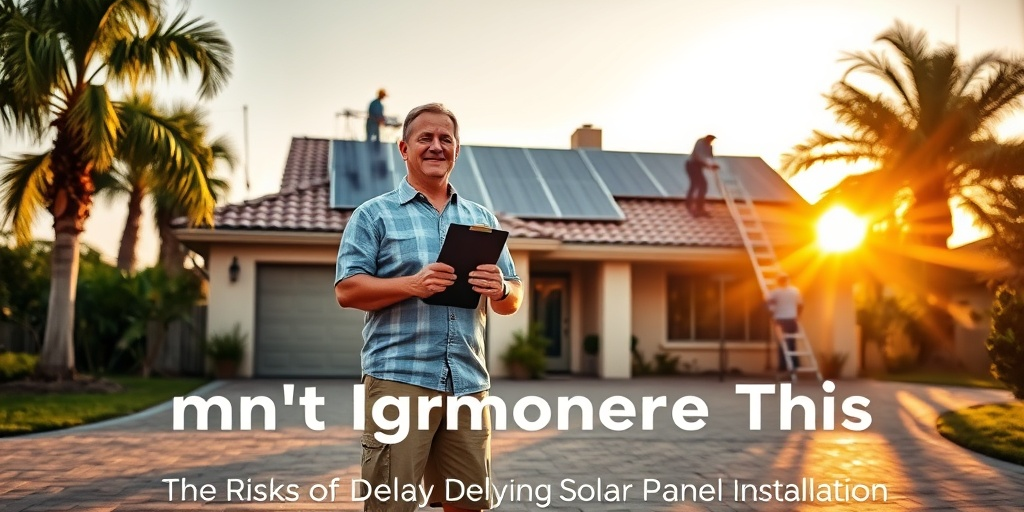
Did you know that 2025 is poised to be a landmark year for solar energy in Florida? Reports from the Solar Energy Industries Association (SEIA) reveal that solar capacity in the state is estimated to increase significantly, yet many homeowners are still hesitant to make the switch to solar power. Delaying solar panel installation can cost you financially and impact your energy independence, particularly in an era marked by rising energy costs and unpredictable grid stability. In this article titled Don’t Ignore This: The Risks of Delaying Solar Panel Installation, we will explore the high stakes of postponing your transition to solar energy. A staggering 90% of homeowners who installed solar panels save substantially on their energy bills (Energy.gov). Moreover, with new incentives being introduced in 2025, it is crucial to act now. We will dissect the risks across five key sections, including a deep dive case study, a practical checklist to guide your decision-making, a myth-busting segment to dispel common misconceptions, a local focus on Florida’s solar policies, and a technical analysis of the latest innovations in solar technology. Understanding these aspects is vital to make an informed decision that benefits you and future generations.
Understanding the Hidden Costs: A Case Study on Delaying Solar
Imagine a family in Miami, the Rodriguez family, who had been contemplating solar energy for over two years but continuously postponed their installation. Every month, electricity costs soared, and the uncertainty surrounding future energy prices haunted their dreams. In 2024, a major storm caused widespread power outages across Florida, and they faced even higher energy bills due to their reliance on backup generators. After finally installing solar panels in early 2025, they discovered that they could have saved thousands had they acted sooner.
In 2025, facing a looming $5,000 increase in their annual energy expenses due to power company rate hikes, the Rodriguez family learned the hard way that waiting had significant consequences. They missed out on state rebates and federal tax incentives that are now significantly reduced as state solar policies evolve. Recent studies indicate that Florida ranks fourth nationally for solar energy jobs, and employability in this sector continues to grow (SolarJobs.org).
- Step 1: Understand the true cost of electricity in your area.
- Step 2: Calculate how much you could save monthly.
- Step 3: Research available incentives and rebates.
Many homeowners might think that by delaying solar installation, they can avoid upfront costs. However, rising electricity prices approximately double every 20 years (Energy.gov), making solar power not just a solar dream but a financial necessity. The cost of inaction can be far greater than the initial investment in solar technology, especially when factors like rising energy prices and climate change create a perfect storm.
So, how can Florida residents avoid making the same mistake as the Rodriguez family? Start by preparing an actionable checklist:
- Audit your current energy needs.
- Identify potential savings with solar.
- Consult an expert at floridaelectricandsolar.com.
By taking steps now, you can avoid the costly repercussions of waiting. Just as the Rodriguez family learned through trial and error, acting swiftly enables you to harness the financial and environmental benefits that solar energy provides.
Checklist: How to Make the Most of Your Solar Transition
Ready to take the plunge into solar energy? Here’s a comprehensive checklist:
- Step 1: Audit Your Energy Usage
- Step 2: Research Available Incentives
- Step 3: Consult a Trusted Solar Provider
- Step 4: Assess Your Home’s Solar Suitability
- Step 5: Plan for Energy Storage Options
Begin by reviewing your past utility bills. This will give you an understanding of your monthly energy consumption and help establish how much you could potentially save by switching to solar.
Be aware of the Federal Investment Tax Credit and various state-level incentives designed to make solar energy more affordable. As of 2025, the federal tax credit is set to decrease, making immediate action crucial.
Speak to experts at floridaelectricandsolar.com who can help you navigate the process of installation and financing options available for your unique needs.
Conduct an evaluation of your roof’s orientation, material, and shading to ensure optimal sun exposure for solar panels. Florida roofs can harness sun potential, but not all roofs are created equal.
Consider exploring battery backup systems that can store energy for use during outages. Investing in battery technology can further enhance your energy independence.
Using this checklist, Florida homeowners can make informed decisions about their solar journey. Managing the transition to solar requires careful consideration, yet the benefits—financially and environmentally—are immense.
Myth Busters: Debunking Common Solar Misconceptions
Myth #1: Solar Energy Is Too Expensive
Many homeowners believe that solar power is reserved for the wealthy. In reality, installing solar panels has become increasingly affordable, with financing options and incentives available to assist in reducing the initial investment (SEIA.org).
Myth #2: Solar Panels Are Ineffective in Overcast Weather
While it’s true that solar panels generate less electricity in cloudy conditions, they can still harness energy efficiently even on overcast days. In Florida, particularly with an average of 237 sunny days per year, the efficiency of solar panels is markedly high (Weather.com).
Myth #3: Solar Panel Installation Is Complicated
Contrary to popular belief, the installation process has become streamlined with advancements in technology. Solar companies now manage most aspects of the installation, making it easier than ever for homeowners to switch to solar power.
Myth #4: Solar Is Only Beneficial for New Homes
Nothing could be further from the truth. Existing homes can also be retrofitted with solar panels, meaning it’s never too late to embrace solar energy for cost savings and environmental benefits.
Myth #5: Solar Panels Require Constant Maintenance
Most solar panels require minimal maintenance. A simple rinsing to remove dirt and debris a couple of times a year is usually sufficient to keep them functioning efficiently.
By addressing these common misconceptions, homeowners can make better-informed decisions regarding solar investments and understand the vital role solar panels can play in their energy future.
Florida’s Solar Landscape: A Local Focus on Policies and Technologies
The Sunshine State is known for its commitment to expanding solar energy access. As of 2025, several local policies are incentivizing the shift to renewable energy, making it more advantageous than ever for homeowners to switch. Florida’s net metering policy allows homeowners to receive credits for the excess electricity generated by their solar systems (SolarReviews.com). This incentivizes solar installation as it helps offset monthly energy costs.
Additionally, the state is actively invested in enhancing its solar infrastructure and promotional campaigns aimed at raising public awareness regarding solar energy benefits. Recent statistics show that Florida ranks second nationwide for installed solar capacity, with over 3,600 MW of solar currently deployed (SEIA.org).
- Florida Solar Rebates: Understanding the local incentives.
- Net Metering: The importance of receiving credits from surplus energy.
- Investment in Infrastructure: How Florida is paving the way with innovative projects.
By tapping into these resources, Floridian homeowners can leverage their investments in solar technology and contribute to a greener community.
Next Steps for Florida Solar Buyers in 2025
Ready to take the plunge into solar energy? Here’s a robust action plan:
- Step 1: Audit Your Electric Bill
- Step 2: Evaluate Your Home’s Solar Potential
- Step 3: Consult Solar Experts
- Step 4: Explore Financing Options
- Step 5: Stay Informed on Policy Changes
Collect at least a year’s worth of electric bills to assess your energy consumption patterns. This snapshot helps you understand your specific needs.
Check for shading from trees or adjacent buildings. Florida’s abundant sunshine offers significant opportunities, but clearing shading can enhance your solar efficiency.
Speak with experienced solar consultants from floridaelectricandsolar.com who can provide detailed analyses tailored to your location.
Investigate various financing options, including solar loans, leases, and power purchase agreements (PPAs), to determine what works best for you.
Keep abreast of upcoming changes in local solar policies and incentives to maximize your returns and benefits from your solar investment.
The process of going solar doesn’t have to be overwhelming when approached methodically. By following this checklist, Florida residents can simplify the transition to cleaner energy while ensuring that they are well-informed on available incentives and savings.
As we have explored in this extensive article, delaying solar panel installation involves significant risk—not just financially, but for the planet as well. The technology is hands-down accessible, viable, and beneficial for homeowners across the state. With incentives likely to phase down and energy costs rapidly increasing, now is the time to act.
Investing in solar energy enables you to cut electric bills, enhance your home’s value, and absorb sun rays instead of soaring energy expenses. Don’t let uncertainty prevent you from joining the solar revolution. Embrace the future of energy.
Ready to start your solar journey in 2025? Connect with a certified expert at floridaelectricandsolar.com today.
Related Articles
More insights about Solar Panel

Florida Homeowners: Why Solar Panel Maintenance Is Essential

7 Essential Steps for Solar Panel Installation Success

Expert Insights: Key Factors Influencing Solar Panel Lifespan
Ready to Go Solar?
Have questions about solar energy? Our experts are here to help you make the switch to clean, renewable energy.