
Flat Roof Solar Mounting in Florida: A Complete Installation Guide
Share:
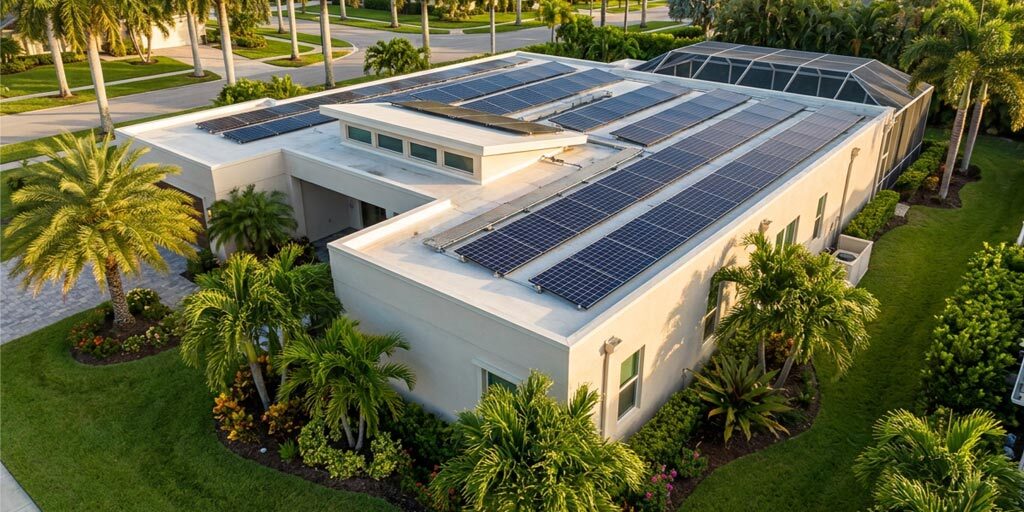
Walk through almost any commercial district in Tampa or Miami and you’ll see flat-roofed buildings with rows of solar panels angled toward the sky. But flat roofs aren’t just a feature of commercial buildings, and many residential homeowners have flat roofs too. If your home has one, you may be wondering whether it disqualifies you from going solar.
Flat roofs are actually well-suited for solar installations, and in some ways offer more flexibility than a sloped roof. The key is in the mounting approach, and understanding the two main options helps you ask better questions when you talk to an installer.
This guide covers how flat roof solar mounting works, how installers think about tilt angle, and what you need to know to make a confident decision.
Key Takeaways
- Flat roofs are fully compatible with solar — both residential and commercial flat-roof systems are installed regularly throughout Florida.
- Two main mounting approaches exist — ballasted (non-penetrating) and mechanically attached (penetrating), each with genuine tradeoffs.
- Tilt angle matters more on a flat roof — mounting systems adjust panel angle to optimize production at Florida’s 25–30°N latitude.
- Proper installation doesn’t damage your roof — a qualified installer accounts for structural load, waterproofing, and wind uplift before designing your system.
- Commercial flat roofs are a particularly strong solar use case — large unobstructed surface area and high energy loads make the economics compelling.
Flat Roof Solar in Florida: Why It Works
Orientation and Tilt: The Flat Roof Advantage
Solar panels need to be facing south and at the proper tilt to maximize production. A sloped residential roof has a natural built-in angle, but rarely are homes built to face the optimal direction for solar. A flat roof doesn’t have this problem.
What This Means for Florida
Florida’s position between roughly 25° and 30° north latitude makes flat roof solar particularly productive. At that latitude, a south-facing panel tilted at around 25–30° captures near-optimal annual energy. Since a flat roof allows installers to choose both orientation and tilt angle freely, there’s no compromise on positioning the way there might be with a roof that faces east or west at a fixed pitch. Flat roof systems in Florida regularly perform at or above projections for similarly sized sloped-roof systems.
The Two Main Flat Roof Solar Mounting Approaches
There’s no single “right” way to mount solar on a flat roof. Installers choose between two primary systems based on your roof type, structural characteristics, and local wind requirements.
Ballasted (Non-Penetrating) Systems
A ballasted system anchors the panel frames to the roof using weight — typically concrete blocks or heavy rubber-coated ballast — rather than fasteners that penetrate the roofing membrane.
How it works:
Low-profile aluminum frames sit directly on the roof surface. Ballast blocks, typically 20–50 lbs each, are distributed across the frame to hold the system in place against wind uplift. No holes are drilled into the roof.
The upside:
Because no penetrations are made into the membrane, there’s no risk of compromising the waterproofing layer. For roofs under warranty, penetrations can void coverage, and ballasted systems are also faster to install and easier to remove if the roof needs replacement.
The tradeoff:
Weight. A ballasted system adds meaningful load to the roof structure — typically in the range of 3–5 lbs per square foot depending on tilt angle and wind zone. Before recommending this approach, a qualified installer reviews the roof’s structural load capacity, which may require a structural engineering sign-off.
Best for:
Commercial flat roofs with built-up roofing (BUR) or TPO/EPDM membranes in good condition. Also used on residential flat roofs where the structure supports the load.
Mechanically Attached (Penetrating) Systems
A mechanically attached system fastens the mounting hardware directly to the roof deck or structural members using bolts or screws that penetrate the roofing membrane.
How it works:
Mounting feet are bolted through the membrane and into the structural deck, then sealed with flashing and roofing-compatible sealant to create a watertight connection. The panel frames attach to these mounted feet.
The upside:
Greater resistance to wind uplift. Mechanically attached systems are generally the more stable choice in high-wind conditions, which matters in Florida during hurricane season. The system puts less dead weight on the roof since it relies on mechanical attachment rather than ballast mass.
The tradeoff:
Penetrations require careful waterproofing. A properly detailed installation uses flashing and sealant systems designed for the specific membrane type and carries a flashing warranty. Done correctly by a certified installer, the penetrations are fully weatherproof. Done incorrectly, they become leak points, which is why choosing a licensed, experienced installer is non-negotiable on penetrating systems.
Best for:
Residential flat roofs where wind performance is a priority and the membrane allows for clean penetration and re-sealing.
Why Tilt Angle Matters at Florida’s Latitude
Solar panels installed at 0° on a flat roof will produce power, but not as much as they could. At true horizontal, panels collect direct sunlight only when the sun is directly overhead, and they’re prone to water pooling and debris accumulation that reduces output over time.
Florida sits between 25° and 30° north latitude, meaning the sun arcs across the southern sky at a relatively high angle year-round compared to northern states. For a south-facing panel, tilting solar on a flat roof to roughly 20–30° captures close to peak annual production at this latitude.
There are some nuances worth understanding:
- Lower tilt (10–15°) increases summer production when the sun is highest and reduces the surface area exposed to wind — recommended for exposed coastal sites where wind loading is a primary concern.
- Higher tilt (25–35°) increases winter production and can be optimal for homes or businesses whose energy demand peaks in cooler months. It also improves self-cleaning from rain.
- Steeper tilts create more row shading — shadows cast by rows of panels on each other during key productive hours. The deeper the angle, the more spacing is needed between rows, which affects how many panels fit on a given roof area.
Experienced installers balance latitude optimization, wind zone, roof load limits, available space, and energy demand profile to arrive at a tilt recommendation specific to your property. There’s no universal correct angle, but there is a right answer for your roof.
Can Solar Panels Damage a Flat Roof?
This is worth addressing directly, because it’s one of the most common concerns homeowners raise. A properly designed and installed flat roof solar system should not damage your roof. Here’s what a qualified installation accounts for:
- Structural load: Before recommending a mounting system, the installer evaluates the roof’s load capacity. For ballasted systems, this typically involves a structural assessment to confirm the roof can carry the added weight.
- Waterproofing integrity: On penetrating systems, every fastener point is flashed and sealed using materials compatible with your specific membrane. On ballasted systems, the frames rest on rubber pads that protect the membrane from abrasion.
- Wind uplift: Florida’s wind zones require that mounting systems be engineered to specific uplift resistance. Both ballasted and penetrating systems are designed to meet or exceed local wind load requirements.
- Drainage: A well-designed system accounts for your roof’s drainage paths and doesn’t obstruct them. Pooling water around mounting hardware is a failure of installation, not an inherent risk of solar.
The risk to a flat roof comes from a poorly specified or improperly installed system. A qualified installer — NABCEP-certified and carries all required Florida contractor licensing — will evaluate your roof condition, load capacity, and structural compatibility before any system is designed. If your roof isn’t a good candidate for solar, they’ll tell you. You can see what a thorough pre-installation evaluation looks like in the Florida residential solar installation process.
Flat Roof Solar for Commercial Properties
While this guide is written primarily for homeowners, commercial flat roof solar in Florida deserves a mention. A large commercial flat roof offers unobstructed space, no chimneys or dormers to work around, and usually a south-facing orientation with no neighboring structures casting shade.
Commercial solar installations in Florida range from small 100 kW rooftop builds to large 1 MW+ systems. The same mounting principles apply — ballasted vs. mechanically attached, tilt angle optimization, wind zone compliance — but at a scale where the financial impact is immediate and substantial.
Frequently Asked Questions
Can solar panels damage my flat roof?
A properly designed and installed system should not damage your roof. Qualified installers assess structural load capacity, use waterproof flashing at all penetration points, and engineer the system to Florida’s wind uplift requirements. The risk comes from poor installation, not from solar itself. A full site survey before any system is designed confirms whether your roof is a good candidate.
Which mounting system is better for Florida — ballasted or penetrating?
Neither is universally better. Ballasted systems avoid roof penetrations and are well-suited for large flat commercial roofs with adequate structural load capacity. Penetrating systems offer stronger wind resistance and are often the right choice for residential flat roofs in higher wind zones. Your installer will recommend the appropriate system based on your roof type, structure, and location.
Do I lose roof warranty coverage if I install solar on a flat roof?
It depends on your roof warranty and the mounting approach. Ballasted systems typically do not penetrate the membrane and are less likely to affect warranty coverage. For penetrating systems, a licensed solar contractor’s flashing work may or may not be covered depending on the terms. Reviewing your roofing warranty before installation is a smart step, and your installer should be able to walk you through what to check.
What’s the optimal tilt angle for solar panels in Florida?
For most Florida installations, a tilt between 20° and 30° captures near-peak annual production. The exact angle depends on your latitude, available roof space, wind zone, and whether you want to optimize for summer, winter, or year-round production. Your installer calculates this as part of the custom system design.
How long does the installation process take for flat roof solar?
The timeline is similar to a standard residential installation: roughly six to eight weeks from consultation to activation, including permitting and utility approval. The physical installation itself typically takes one to three days.
Find Out If Your Flat Roof Is a Good Fit for Solar
If your home or business has a flat roof and you’ve been unsure whether solar makes sense, a free consultation is the fastest way to get a real answer. Florida Electric & Solar will evaluate your roof, your energy use, and your site conditions — and give you a custom quote. Get a free quote and learn what a system designed for your roof can do for your wallet.
Related Articles
More insights about Solar Installation

How Long Do Solar Panels Last in Florida? What to Expect From Your System

Myth: Solar Panels Don’t Increase Home Value in Florida

Expert Insights: The Lifespan of Solar Panels Explained
Ready to Go Solar?
Have questions about solar energy? Our experts are here to help you make the switch to clean, renewable energy.