
Solar Panel Financing in Florida: Loans, Leases, and $0-Down Options for 2026
Share:
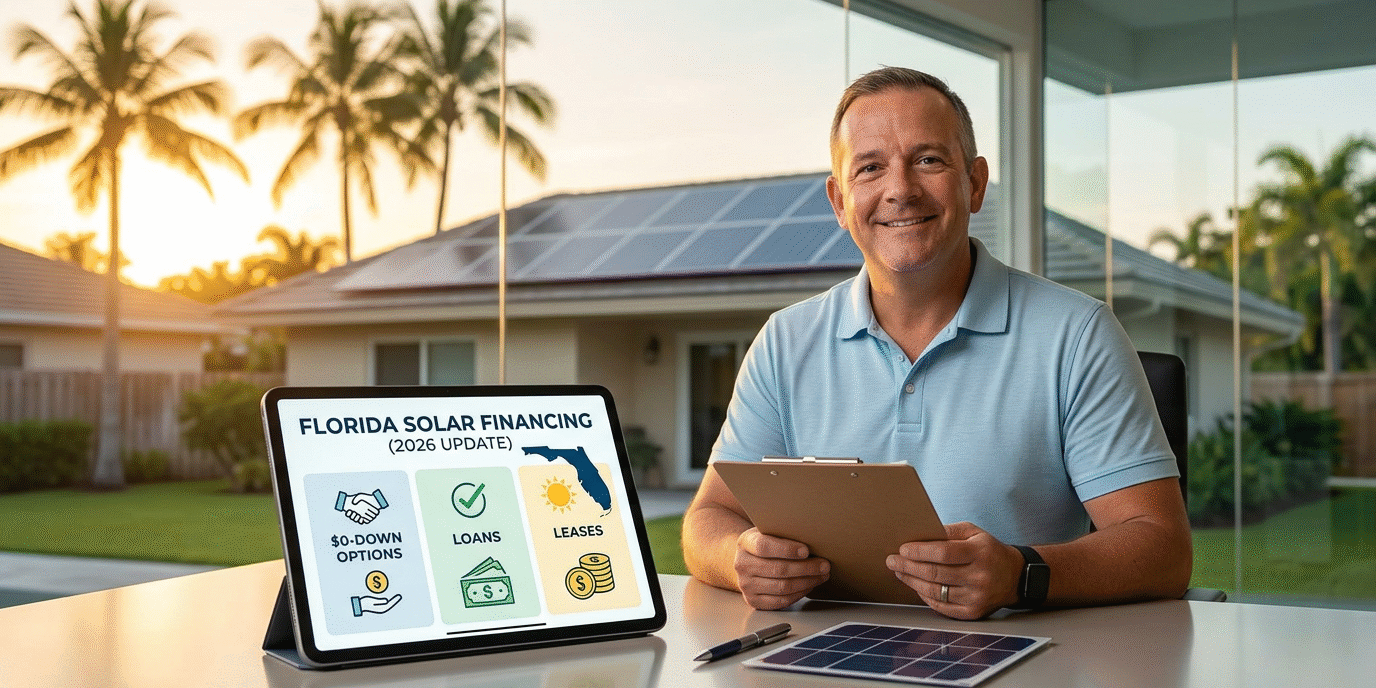
Going solar makes long-term financial sense for most Florida homeowners, but the upfront price tag can feel like a dealbreaker before you ever get to the savings. The options are plentiful, and so is the jargon that comes with them.
The good news: accessible paths to solar ownership exist at every budget level, including several $0-down options that let you start saving from day one. This guide evaluates every major financing route in plain language so you can make an informed decision.
Key Takeaways
- Cash purchases deliver the fastest payback period and highest lifetime return on investment.
- Solar loans offer full ownership with no large upfront payment, and monthly costs are often lower than your current utility bill.
- Leasing requires minimal commitment but generates less long-term value and can complicate a home sale.
- PACE financing is equity-based rather than credit-based, making it accessible to homeowners who don’t qualify for conventional lending.
- Florida’s sales tax exemption applies automatically to solar equipment purchases, reducing your upfront cost with no paperwork required.
How Florida Homeowners Finance Solar Panels
Most Florida homeowners choose one of three paths when it comes to paying for solar: cash, a traditional loan, or a lease. Each works differently, and the right choice depends on your financial goals, how long you plan to stay in the home, and how much upfront capital you’re comfortable using.
Paying Cash for Solar
If you have the capital available, a cash purchase is the simplest and most financially rewarding path. You own the system outright from day one, which means you keep 100% of the energy savings and add verified equity to your property. There are no monthly loan payments, no interest charges, and no third-party contracts to navigate. For homeowners who can absorb the upfront cost, cash typically delivers the fastest payback period and the highest lifetime return on investment.
Best for: Homeowners with available savings who want maximum long-term value and full system ownership.
Taking Out a Solar Loan
A solar loan works much like a home improvement loan: a lender covers the cost of your system, and you repay it in fixed monthly installments — often at a rate lower than what you’re currently paying your utility. Terms typically range from 5 to 20 years depending on the lender.
Because your loan payment often runs lower than your previous electric bill, many homeowners see positive cash flow from month one — even before the loan is paid off.
Best for: Homeowners who want full ownership without tying up a large sum of cash.
Opting for Solar Leasing
With a solar lease, a solar company installs panels on your roof and retains ownership of the system. You pay a fixed monthly fee — typically lower than your current electricity bill — in exchange for the power the panels produce. Leases generally require little to no money down and remove the headache of maintenance, since the system owner remains responsible for upkeep and repairs.
The trade-off: since you don’t own the system, leases can complicate home sales if a buyer isn’t willing to take over the agreement. Leasing tends to generate less long-term value than ownership, but it’s a practical entry point for homeowners who aren’t ready to commit to a purchase.
Best for: Homeowners who do not foresee selling their home in the near future and want immediate bill reduction with minimal commitment and no maintenance responsibility.
What Is PACE Financing and Why Is It Popular in Florida?
PACE — Property Assessed Clean Energy — is a unique financing model that operates differently from any traditional loan. Instead of taking out a personal loan or line of credit, PACE financing is tied directly to your property, which changes how approval works and how repayment is structured.
How PACE Works
A PACE program funds your solar installation upfront. That amount, plus interest and fees, is then spread across your property tax payments over a term that typically runs 5 to 25 years. A few things that set it apart from conventional financing:
- Approval is equity-based, not credit-based — qualification depends on your home equity rather than your credit score, making it accessible to homeowners who may not qualify for traditional loans
- Repayment is folded into your property tax bill — for homeowners who pay taxes through an escrow account, this can feel administratively simpler than managing a separate monthly payment
- The obligation can transfer with the home — if you sell before the balance is paid off, the remaining PACE lien generally transfers to the new owner as part of the property
Why PACE Is Especially Common in Florida
Florida has one of the most established PACE infrastructures in the country, with multiple active programs operating statewide. That accessibility, combined with the equity-based approval process, makes it a popular option for homeowners who want $0-down financing without going through a traditional lender.
What to Know Before You Sign
PACE financing isn’t without tradeoffs. A few important considerations:
- It carries interest — and the total cost of borrowing can be higher than some traditional solar loans. Always compare the full cost before committing.
- PACE liens are senior to mortgage liens — this means your mortgage lender has a junior position, which can complicate refinancing and may require lender consent. Talk to your lender before moving forward if you have an existing mortgage.
- Selling your home requires a conversation — while the lien can transfer to a new owner, not all buyers will accept this, and it’s worth discussing with your real estate agent and solar installer before signing.
Florida’s Solar Sales Tax Exemption
Florida also exempts solar energy equipment from state sales tax — a straightforward benefit that reduces your upfront cost. When you purchase solar panels and related components in Florida, you don’t pay state sales tax on those materials — a meaningful reduction on a five- or six-figure purchase.
This benefit applies automatically at the point of sale and requires no additional paperwork on your part. It’s one more reason why going solar in Florida makes strong financial sense even before you factor in long-term utility savings.
What ‘$0 Down’ Means — and What It Doesn’t for Florida Solar Buyers
“$0 down” is one of the most common phrases in solar marketing. Here’s what it means for Florida homeowners considering their financing options.
What It Means
In most cases, “$0 down” means you’re financing 100% of the system cost — through a solar loan, PACE financing, or a lease — with no money required at signing. Your monthly payments begin after installation, and those payments are ideally structured to run lower than your previous utility bill, creating immediate net savings.
What It Doesn’t Mean
“$0 down” does not mean the solar system is free. You’re still paying for it over time, typically with interest. The value of a $0-down structure is that it removes the barrier of a large upfront payment and lets you redirect what would have been out-of-pocket costs toward a monthly payment that’s offset by your energy savings. When structured correctly, it can be genuinely cash-flow-positive from month one.
Frequently Asked Questions About Solar Financing in Florida
Is it better to buy or lease solar panels?
Buying almost always delivers greater long-term value — you own the system, keep 100% of the savings, and add equity to your home. Leasing offers lower upfront commitment but generates less return over time and can complicate a home sale.
How much do solar panels cost in Florida?
Systems typically start at $15,000 for 6 kW, $25,000 for 10 kW (the most popular size), and $37,500 for 15 kW. Every system is custom-quoted based on your energy usage and roof layout.
What’s the best solar financing option for most Florida homeowners?
For most homeowners, a traditional solar loan is the strongest starting point — payments are often lower than a typical utility bill and you retain full ownership benefits. PACE is worth exploring if you don’t qualify for conventional lending.
Does financing solar panels affect my home’s value?
Owned systems — purchased with cash or a loan — increase home value because the asset transfers with the property. Leased systems typically do not, and can require buyer approval to transfer the lease agreement at sale.
Start Saving: Get Your Free Solar Financing Quote in Florida
At Florida Electric & Solar, we work with homeowners every day to find the financing structure that fits their goals, whether that’s maximum long-term savings, a $0-down entry point, or something in between. We’ll run the numbers on your actual energy bill and walk you through every option before you make any decisions. Get your free quote and discover how much you can save by going solar with us.
Related Articles
More insights about Financing Options

What Are the Critical Financing Options for Solar Panel Installation?

What Are the Best Financing Options for Solar in Florida

Top Financing Options for Solar Panel Installation in Florida
Ready to Go Solar?
Have questions about solar energy? Our experts are here to help you make the switch to clean, renewable energy.